

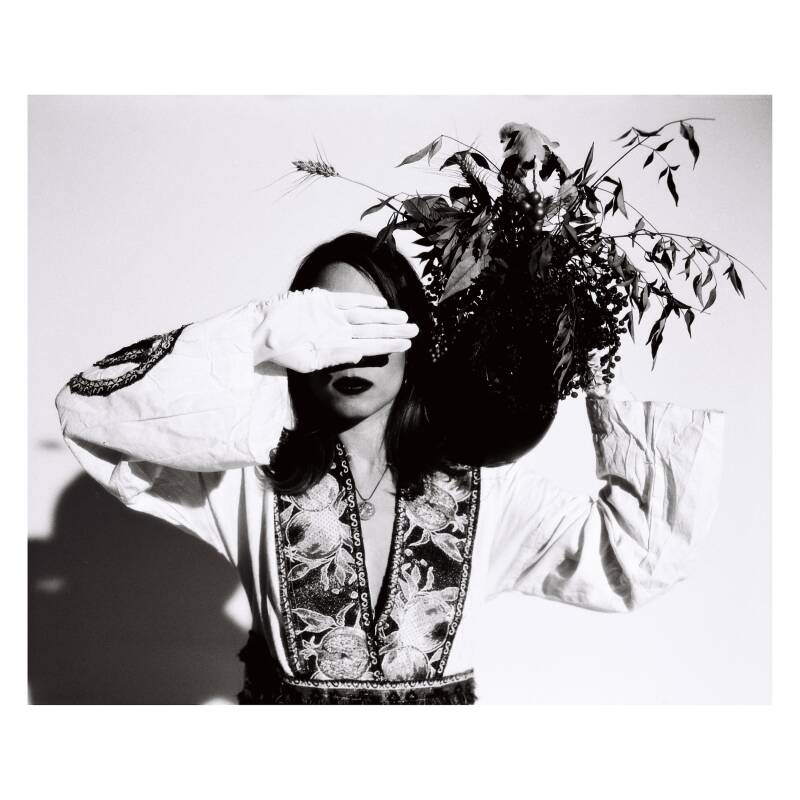
You’re a Georgian-American artist now based in Nashville, blending Alt-Americana, folk, and alternative rock. How has your journey from Tbilisi to Nashville shaped the sound and spirit of ‘Are You There?’
The immigrant experience is at the heart of this record. The feeling of being a stranger wherever you go with no home to return to. “Cross the Water” explores that theme more in depth but that through-line is there for the entire album.
This album feels like a significant statement following your previous releases like ‘Whispers and Sighs’ and ‘Detour’. What made this the right time to create and release the new album?
I heard someone say once “you can criticize me all you like, but you can’t say I wasn’t contemporary.” Creating this record was a way to reflect the times we’re living in.
The title ‘Are You There?’ carries a sense of searching or reaching out. What does the title mean to you personally, and how does it tie the album together?
Are You There? came from the post-chorus hook on Cordelia. It had the right ring for the title and I liked that it was a question. Album titles are the first thing people look at but questions really come alive when we stop looking at them and start looking through them. Beyond that, who knows what anything means.
Several songs seem to draw from personal and global experiences—such as migration, leaving one’s homeland, and the tension between desperation and hope. Can you talk about how real-life events influenced specific tracks like “Cordelia,” “Cross The Water,” or “There Is A War”?
I don’t think the writing process of Cordelia was inspired by any real-life event but throughout the recording of it, the theme of truth kept coming up. In King Lear, Cordelia’s the one that tells the truth and gets punished for it. I’m very lucky that I get to call some of the most courageous people and freedom-fighters I know my friends. They’re artists, photographers, journalists and they’re the ones protecting the truth while actively trying to make the world a better place everyday. I can’t think of a better real-life inspiration for the track than that.
Cross the Water is a song about migration, passages. You’ve crossed the water and there’s no going back. You can’t step into the same river twice.
“There Is a War” explores the inherent divisions within society and within ourselves. It’s a difficult song to sing without making it sound like a slogan. It is not an endorsement of violence, but a recognition of the inescapable conflicts that shape human existence. Peace is never mentioned, yet its absence forces you to think about it. You can hardly think about war without contemplating peace, and once you do, you begin to question what it actually means, whether it is merely the absence of war or something else. The war in Ukraine and the 2008 war in Georgia definitely influenced the creation of this track.
The songwriting balances the deeply personal with the universal. Was it a conscious choice to make these songs feel intimate yet broadly resonant?
Happy to hear that it feels that way to you. There’s a saying among songwriters - “write what you know”. I suppose that’s at work here. But I don’t think it’s a particularly conscious choice for me, and in this case for Irakli as well. The “global” and the “personal” are very intertwined.
For example, the war in Ukraine, Russian aggression, these things are literally close to home for us, close to our home country, Georgia, and to our relatives and friends. It’s not abstract. The same goes for the problems in the U.S.
And then there’s one indisputable fact of life, the impermanence of it all. The awareness of that, and how you deal with it, is as universal as it gets. Everyone has their own deeply personal way of facing it, but it’s also something that can, and should be a unifying force among humans everywhere.
You’ve mentioned that ‘Are You There?’ is “not an escapist record.” How do you approach writing about heavy topics like war, chaos, and human connection without it feeling overwhelming for listeners?
I find it impossible not to care deeply about all the pain and suffering in the world, yet simultaneously, my survival instinct urges me to escape from it and find refuge in innermost places. I find that I'm walking around with a lot of undigested emotions when it comes to the contemporary chaos around us. Songwriting is that digestive aid for me. Sometimes it works instantly and sometimes it has a time release effect.

How did the production process evolve, and what role did your collaborator Irakli Gabriel play in bringing these songs to life?
Irakli’s the co-author of the album, as well as a co-producer. We usually begin in Logic, building out demos until they feel solid enough to take into the studio, but this time the process leaned much more into experimentation and exploration. A lot of the sonic identity came from being willing to follow ideas further than we normally would.
Irakli’s always pulling from a well of musical knowledge and he brings that into the room in a way that never feels forced. What I value most is his sense of perspective. He has a way of seeing a big picture when it comes to production while I can often get lost in details. That balance is everything. He keeps things moving and elevates the work without overcomplicating it.
Tracks like “Infinitely Blue,” “Soldier,” “Red Desert,” and “Only The Fool Remains” appear on the album. Is there a song that was particularly challenging to write or record, and what made it so?
Writing-wise, I don’t recall any particular challenges. Many of these songs were written with David Olney while he was still with us. We had just finished the record Whispers and Sighs, and were all inspired to write and record more. So David, Irakli, and I were very much in the flow, and it feels like songs like “Cordelia,” “Infinitely Blue,” and “Only the Fool” came together almost in one breath.
Recording and mixing took a while. We tried different instruments and approaches for each song, then had to sift through all the ideas, keep what we liked most, and let go of the rest.
“Cordelia” in particular went through several transformations, and thankfully the brilliant Mark Plati, whom we knew through his work with David Bowie and had played with in New York some years ago was available and willing to give an outside perspective and mix the track.
“Red Desert” was particularly fun to record. It’s the only track that features two drummers, Nashville aces Chris Benelli and Justin Amaral, playing at the same time, and the whole band was live, apart from the horns, which Alvin Davis overdubbed from London. The producer of the record, Charlie Chamberlain, came up with some really cool parts and sounds for the middle section.
How did your multidisciplinary background as a singer-songwriter and artist influence the overall vision or even the visual elements (artwork, videos) for this project?
I’m very influenced by multidisciplinary artists, people like David Bowie, Kate Bush, Dennis Hopper, Laurie Anderson, WIlliam Blake or Charlie Chaplin. The artwork specifically was inspired by Sergo Parajanov, who’s a quintessential multidisciplinary artist for me.
The album touches on purpose, love, death, and consciousness in an accessible way. Is there a particular lyric or moment on the record that feels especially vulnerable or meaningful to you right now?
“Dreamers have a secret, lovers know it’s true” from Infinitely Blue.
You’ve collaborated with legendary figures like the late David Olney in the past. Did any of those experiences or lessons carry over into the making of ‘Are You There?’
Living in New York, and now in Nashville for the past 8 years, being part of a tight-knit but wide musical community has been really inspiring. You end up in the company of, getting to know and collaborating with incredible people, some of them real heroes of mine, like David Olney, Mike Scott, and Mary Gauthier. Even just being in the same room with artists like that can be a huge learning experience.
I remember doing a celebration show for Mary Gauthier's ‘Drag Queens in Limousines” with lots of great Nashville artists on the bill. We were all backstage, and Emmylou Harris was there in the corner, going over her lyrics, still working on her song right before going on. And I remember thinking, she could do anything and it would sound incredible, she’s one of the greatest ever, and she’s still putting in that kind of work to get it right, whatever “right” means to her.
It’s been similar working with Mike Scott and The Waterboys. We’ve toured together, played on stage with them, worked on videos and recordings. Mike works incredibly hard on every detail - sound, mixes, everything - but he also knows when to let go, when something is done. That balance is such a big challenge, especially for less experienced artists. Seeing how people at that level work has been really helpful and inspiring for me.
Now that the album is out, what kind of response or connection with listeners are you hoping for?
So far the response has been overwhelmingly positive, which is more than I could hope for. Seeing how these songs and themes are resonating with people who’ve heard it has been really meaningful.
With a question like Are You There?, you want it to be the start of a conversation. Not something that feels closed, but something that invites people in, to sit with it, to reflect and maybe even answer it in their own way.
'Are You There?' is out now and you can stream the album below.
Add comment
Comments