

Like all of the best true stories, it’s probably not true. Hugh Glass, American frontiersman, trapper, hunter, and explorer. Left for dead by his companions after being mauled by a bear he survives and becomes something of a folk hero. The story was, at least in part, a work of fiction. It did serve as the inspiration for the hugely successful 2015 movie, “The Revenant”…but it also provided the inspiration for Richard A. Sarafian’s 1971 Western “Man in the Wilderness”. In that version of the story the story of survival and forgiveness is replaced by a story of survival, sure, but of confrontation. Glass is replaced by “Zachary Bass” (Richard Harris) and while Hell bent on retribution he ultimately chooses not to take revenge and instead heads for home to be with his son. Lovely.
In 1996 the former drummer in The Smiths, Mike Joyce, sued Morrissey and Johnny Marr for an equal share of the band’s profits. Joyce believed that both he and bassist Andy Rourke were equal partners with Morrissey and Marr and deserving of 25% each. When the case ended the judge, John Weeks, ruled in favour of Joyce and ordered that he be awarded one million pounds in back payments and the 25% of the band’s profits. In his ruling he described Morrissey, famously, as “devious, truculent, and unreliable”. When Morrissey released his autobiography in 2013 a sizeable number of pages were turned over to the events around the court case, it was clear that the impact on him had been considerable, and not just financially.
Where Hugh Glass had been left for dead by his companions after being mauled by a bear, Morrissey had been mauled by his companions, and had then endured a further mauling at the hands of a judge, before finally being savaged by a gleeful tabloid press. It is difficult to imagine how he could have reached a place of forgiveness as Glass apparently had…and he didn’t. He was left battered, betrayed, and bruised by the whole experience. Sorrow would come in the end.
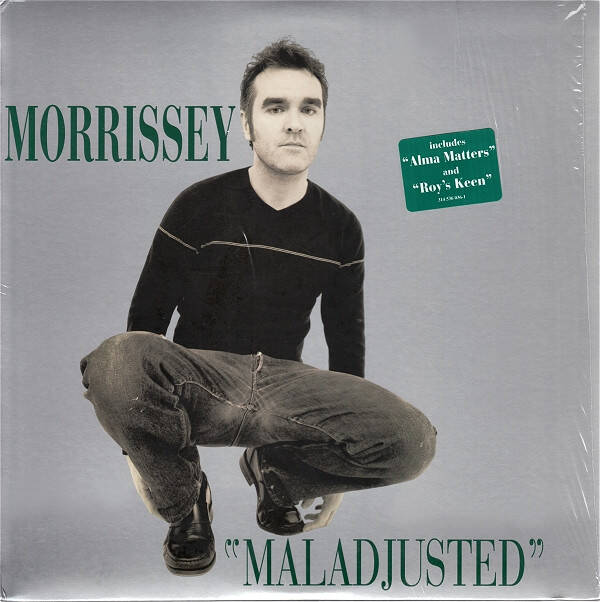
Almost exactly two years after his last solo studio album, 1995’s “Southpaw Grammar”, Morrissey released “Maladjusted” in August of 1997, just a few months after that court case and with the musical landscape of the country in a very different place than it had been in 1995. These was rotten days. The “last party” was coming to an end, cocaine and heroin had taken their toll on some of the key movers and shakers in the world of “Cool Britannia”, and fame, fame, fatal fame, had played hideous tricks on so many brains. Same as it ever was.
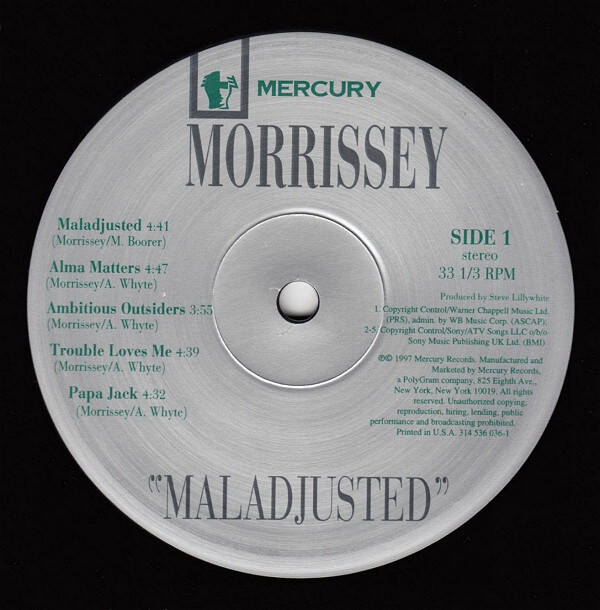
The lead single from the album was “Alma Matters”, released in July just a month before the album’s release. I can remember my shock, and delight, when I saw Moz performing the song on The Jack Docherty Show on Channel 5 as part of the promotional campaign. Docherty wasn’t the host for this episode, Irish comedian Graham Norton was his replacement…whatever happened to him I wonder! Describing Morrissey as a “man who makes music brilliantly” Norton seemed to be genuinely thrilled to be introducing him. Boz Boorer, Alain Whyte, Spencer Cobrin, and Johnny Bridgwood were all present and correct alongside the freshly coiffured Morrissey – his quiff almost gone, but not quite. When the song ended my memory was that Norton rushed towards the band and yelped “The dancing, the dancing…”.
The video for the single showed Morrissey at the Wigan Casino, and at the start of the film there is an appearance, again, from some skinheads – with two sta-prest clad yobs engaging in a bit of the old ultra violence with some other teens. The film progresses with shots of Morrissey playing with a cat, performing the song, and throwing a bowl of cereal over an aggressive skinhead girl who is haranguing him. Like the song itself the whole thing is playful. Fans who had been with him since the days when he was a Smith were delighted that the song included a lyrical reference to “A Taste of Honey” in the line “it’s my life to ruin my own way”.
The album received a lukewarm reception from fans and critics alike on release, despite the fact that it contains some of his best ever songs. Lyrically he is, at times, as good as he has ever been. Musically the band are showing a desire to stretch themselves, to be more experimental, and to avoid doing the expected. Writing in Select magazine in September 1997 Ian Harrison said “It mightn’t have fans forgiving him as with ‘Vauxhall and I’, but there’s still a good deal to recommend ‘Maladjusted’. The voice linked to some fine musical moments, is unchanged….He’s still a star in an increasingly homogenous array. When he bothers to remind us, he’s still a genius making records like no one else.”
Title track and album opener “Maladjusted” is, undoubtedly, one of the very best songs on this, or any, Morrissey album. It is also one of the greatest opening tracks on any album ever, ever, ever. So there. How could anyone disagree with these bold (possibly hyperbolic) statements when the song in question includes lines like this, “As the Fulham Road lights stretch and invite into the night, from a Stevenage overspill we’d kill to live around, south west 6 with someone like you, keep thieves hours with someone like you, as long as it slides…” I mean, come on. You can have as many hours, days, weeks, months, and years as you need…but none of your favourite writers can match him when he’s in this sort of mood.
It opens with a line from Jose Ferrer’s 1955 war film, “Cockleshell Heroes”…another moment when Morrissey has delved deep into his passion for the past and given his fans a cultural treasure hunt to participate in. It took real work for the die hard apostles of the Pope of Mope to find these films, books, and artists he was referencing up to this point in his career – no Google for them.
“There’s not really much point making safe music”. With the second track on the album, “Ambitious Outsiders”, he certainly proved that point. Writing in his “Mozipedia” author Simon Goddard posited the theory that the song was an attempt by Morrissey to give voice to the “unapologetic conscience of a paedophile ring”. That isn’t as peculiar as it may seem on first reading it, Mozzer had used the Moors Murders as the basis for The Smiths “Suffer Little Children” several years earlier, and he often writes from the perspective of a character. Morrissey himself suggested that the song was an exploration of “how easy it is to be seen as somebody who doesn’t belong and has strange ideas.” Whatever the real meaning of the song it is an undeniably disturbing and disquieting track and one that highlights Alain Whyte’s growing skills as a composer.
“Trouble Loves Me” should have been a hit single, maybe even a number one with a fair wind behind it. A ballad of the sort that only Morrissey can deliver, full of maudlin romance and heartbreak. “Show me the barrel and watch me scrape it” is the sort of line that only Morrissey can deliver with conviction. Without question this is the finest moment on the album, and a good argument could be made that it deserves a place at the very top of the Moz pops. In my head I can hear an orchestral version, soaring strings, and I can see Mozzer clutching one of those number one single trophies that so many lesser talents use to prop open the door to the back garden in the summer. It’s a tragedy I tell you.
There is a chance that without the presence of “Trouble Loves Me” that the song that follows it, “Papa Jack”, is viewed more favourably than it is. But sacrificing a song as mighty as “Trouble Loves Me” so that a song as lumpen as “Papa Jack” might not be so loathed is not a price worth paying, or contemplating. This isn’t just about my own personal animus for the song, when the album was reissued in 2009 “Papa Jack” had been memory holed by Moz. There are some nice moments, after about three minutes Mozzer exits and Alain Whyte takes over…guitars roaring and screaming for a bit, a falsetto refrain of “Papa Jack”, but it’s still wafer thin gruel in comparison to what has come before. Oh well, never mind. More interesting than the song is the inspiration for its title, Jack Johnson. Johnson was the first black heavyweight boxing champion of the world, defeating James J. Jefferies in 1910. That victory, coming at the height of the Jim Crow era sparked race riots across the USA. “Papa Jack” is also the tile of Randy Roberts 1985 book about Johnson.
“Ammunition” followed and not just on the track listing, but in being a song that drifted terrifying close to the mundane and forgettable. It is one of those moments when the decision to include it and not give it life as a b-side to a single is baffling. Not even managing to crowbar in the word “chevron” (pronouncing it chev-eh-ron) can lift this above anything more than average. Ironically “Wide to Receive” which was next up was, originally, marked for just such a fate before Morrissey recognised quite how beautiful it was and included it in place of “I Can Have Both” which was itself released as a b-side on “Alma Matters”. “Wide to Receive” was the first co-write with drummer Spencer Cobrin and it suggested that prolonged exposure to the gifts of the likes of Alain Whyte and Boz Boorer might be contagious.
The second single from the album, “Roy’s Keen”, was released in October of 1997 and was more terrifying than anything Halloween offered up. A career low. The previous 22 singles had included genuine classics of English pop, “Suedehead”, “Boxers”, “The More You Ignore Me, The Closer I Get” and others…even frothier or more trivial moments like “You’re the One for me Fatty” were funny and musically engaging. This was just bad. Fortunately it has joined “Papa Jack” in being consigned to the dustbin of history by Mozzer himself. Praise be to God for his tender mercies.
What makes this as baffling as the song itself was terrifying is the fact that the b-sides were among the best songs he had crafted in his career to this point. The second of these, “The Edges are no Longer Parallel” is Alain Whyte’s personal favourite from his career with Mozzer. During a visit to my home in the early 2000’s I can remember the two of us lying on the floor of my tiny flat and playing this song over and over, the light of the setting sun bathing this basement abode in a golden haze, me the super fan singing along with Whyte. A precious moment in a life too ordinary to imagine. As with the “Southpaw” era “Nobody Loves Us” this was a song that deserved so much more than a place in the creative cupboard under the stairs that is the b-side. The same is true of “Lost”, another co-write with Cobrin, a song that is full of hope and romance. “It was an incredible feeling” Cobrin told Simon Goddard “hearing my music with Morrissey’s words. I thought ‘Lost’ was beautiful. I was beyond happy.”
The penultimate track on the album is “He Cried”, a song that manages to drag itself into the ranks of “Maladjusted” better moments thanks, largely, to Morrissey’s vocal performance. Despite being written in the third person there can be no doubt that Morrissey means every word, there is something personal at the heart of the song. It is difficult to imagine that he has never heard the words “I need you” – every one of his adoring fans has told him as much, but perhaps what he is yearning for is something more intimate than the kindness of strangers and those whom he himself has saved? Once again the song suffers from the absence of an orchestral arrangement – so many times on “Maladjusted” I find myself wondering about what might have been, of how things that seem mundane or pedestrian could have been elevated to something greater and grander with more ambition.
Released just a week too late to grab the Christmas number one spot (“Too Much” by the Spice Girls took the prize) “Satan Rejected my Soul” was the third single from the album, reaching number 39 in the charts in the first week of January 1998. A glam stomper in the tradition of his “Your Arsenal” years it is the sort of thing that Morrissey does better than anyone else. Full of righteous fury at the fact that he neither of Heaven nor Hell have any interest in him, Morrissey must have found it difficult to provide a vocal with his tongue planted so firmly in his cheek. This is the sort of song that sets Moz apart from any of his alleged peers, self-deprecating, literate (the lyrics contain a nod to “Wuthering Heights”), funny, an anti-hymn for the grotesque and lonely who make up his base. What none of us knew, how could we, was that this would be the last music we would hear from him until April 2004.
Shortly before “Satan Rejected my Soul” was released I had travelled from my home in Edinburgh to attend Morrissey’s first UK live show of the year at the Battersea Power Station. It was, for so many reasons, a night never to be forgotten. Standing in the line before the show I bought a copy of a fanzine – my memory tells me it was “Sing Your Life”, produced by David Tseng who would later go on to set up the Morrissey fan site, Morrissey Solo. The internet says that I am wrong as the ‘zine stopped early in 1995…maybe Tseng found some old copies down the back of his sofa and brought them to the gig to help cover the cost of flying in from the States?
The Britpop party was beginning to wind down in the UK, collapsing like a dying star from the thrills and spills of the likes of Denim, Saint Etienne, Suede, Pulp, The Auteurs, Echobelly, and Elastica to the lumpen drone rock of Oasis, Ocean Colour Scene and something called Northern Uproar. Oh well. One bright spark in the dark skies of pop were Elcka who were the support act for the night. A curious blend of “Disintegration” era The Cure, early U2, XTC, and with lyrics and themes dark enough to have Lars Von Trier chuckling over his muesli, they were a precious thing. Lead singer Harrold was a pocket rocket of a frontman and their set confirmed that they had everything required to become a big deal…and then it didn’t happen because the record buying public are stoopid.
The venue security had done a wonderful job of preventing the usual rush of adoring fans from reaching the stage, aided by a massive pit between the crowd and the stage that would put shame most medieval castles as a means of defence. But as the opening bars of the closing song of the night, “Shoplifters of the World Unite” (introduced by Moz as “Sorrow Will Come in the End”), chimed I was presented with an opportunity. My partner for the night, a young lady, had attempted to clamber over the barrier…her foot jammed between the crowd and the barrier it took more than one security guard to free her, that created a vacuum in security and I made my move! I was on stage before anyone, including me, knew what has happening. Clad in a pair of lovely vintage Levis, a gingham shirt, and a black single breasted suit jacket I accepted Morrissey’s outstretched hand and then I wrapped my arms around him and kissed the nape of his neck. Another brave soul had made it up at the same moment, I turned to the crowd to accept their applause and then found myself being dragged away by security. But they had made a mistake…holding me by the collar I managed to wriggle out of my jacket and return to the front of the stage once more, Morrissey giving me an approving pat as I did so. Glorious. The whole encounter was captured on film for your delight…
Despite being a part of the “Maladjusted” tour only five of the fourteen songs played were from the album, the rest of the set was made up largely of tracks from “Southpaw Grammar” and “Vauxhall and I”. Walking home through the frosty streets of London to my accommodation (without my jacket which security claimed not to have) I was giddy, it had been 6 years since the first time I had seen Mozzer live and the thrill was as real as ever. I couldn’t know that the next time I would see him appear live would be in May of 2024, so much would change in that time…for both of us.
As with 1995’s “Southpaw Grammar” a better version of “Maladjusted” can be crafted from the songs recorded during the era – not the hodgepodge of cutting and pasting that was the 2009 “redux” release but something more careful. To my mind there are ten tracks that would have made something stronger than either version we have been given;
Maladjusted
Lost
Trouble Loves Me
Alma Matters
Ammunition
I Can Have Both
Wide to Receive
Ambitious Outsiders
Satan Rejected my Soul
The Edges are no Longer Parallel
It might just be me.
As an album it serves as an insight into the life of a tortured star, still capable of moments of outrageous brilliance, but weighed down by the outrageous slings and arrows of former friends, and by the economic and emotional toll of a court case. It is perhaps not all that surprising that the album wasn’t what it might have been.
Only “Alma Matters” appears to still hold any real affection from Moz, continuing to include it in his most recent live dates, but I really do believe that with different choices, possibly with a different producer, something really wonderful could have been produced from these songs, and that might have led to it being more adored than it is.
Add comment
Comments